



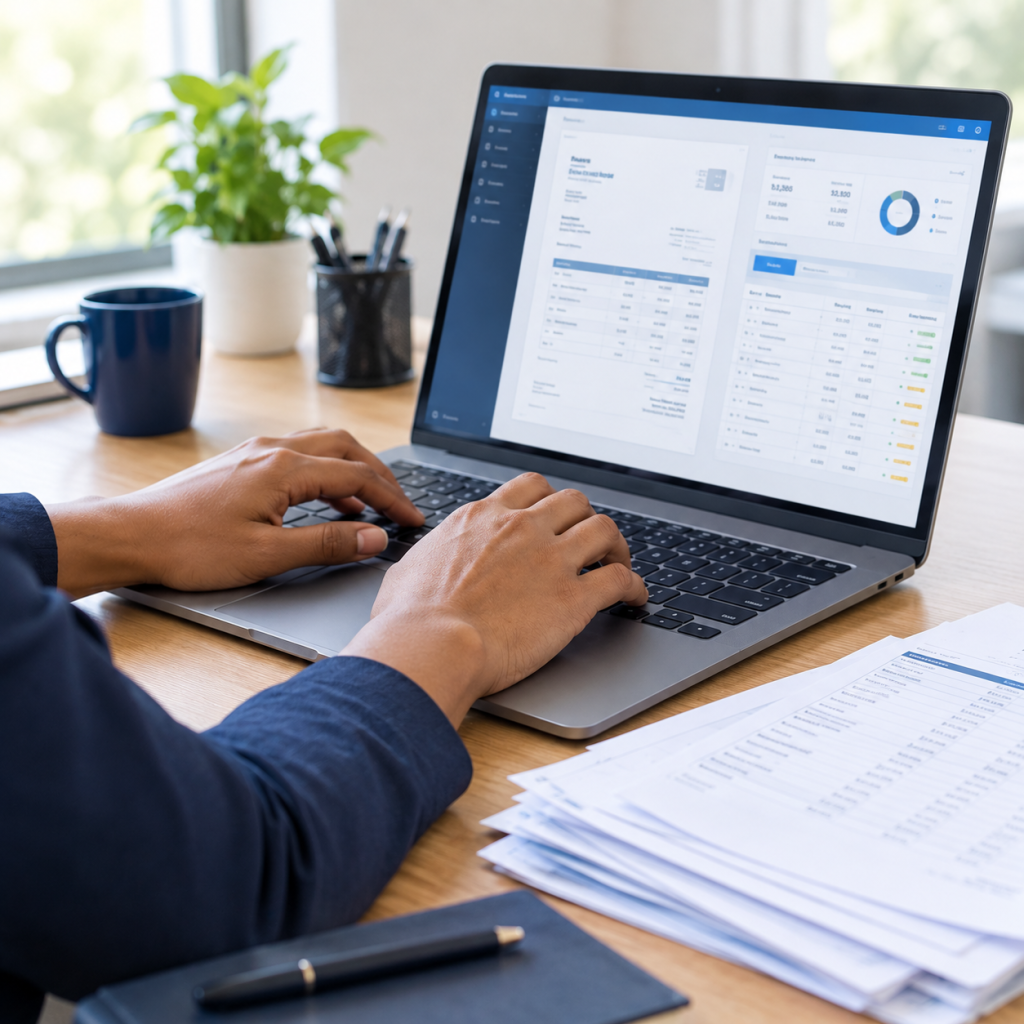
Accounting work is evolving with AI
Accounting work is changing fast. Tools extract invoice data for you, pre-fill entries and reconcile amounts without having to open each document. The question is no longer whether AI will enter an accounting department: it is already there. What remains is knowing how an accounting team genuinely uses it well, without ever losing control of their work.
The calendar makes the subject concrete. According to the electronic invoicing reform relayed by service-public.fr, from 1 September 2026 all French companies must be able to receive their invoices in electronic format. An invoice then arrives already structured, ready to be processed by a tool. What you entrust to it and what you keep for yourself deserves to be examined task by task.
At ScaleMyCrew, this is the vision according to which we set up accounting for our clients. We look at the real work, identify where AI saves time and teach the accountant to use it without relinquishing management. We walk through this approach here on the entire accounting process of an SME, from identifying tasks that lend themselves to it all the way to final validation.
Before automating: identifying tasks that lend themselves to AI
Before installing any tool, you need to look at your own work and sort. Not all accounting tasks lend themselves to AI, and wanting to automate everything at once leads straight to a wall.
A few signs help identify good candidates. A task comes back identically several times a week, such as entering invoices or checking bank statements. Another eats up hours without requiring any particular reflection, such as copying amounts from a PDF into the accounting software. Another still follows clear rules, where a certain type of expense always goes to a certain account. Finally, there are tasks that handle so much information that a person ends up reading them diagonally, for lack of time.
Conversely, a task that requires understanding a new situation or responding before a third party is not delegated to a tool. Sorting is therefore done gesture by gesture, not department by department. The goal is to find the precise moments where a tool saves the accountant time, without ever seeking to replace them.
Using AI effectively: from a simple request to genuine collaboration
An AI tool launched without preparation inevitably returns an approximate result. The difference lies in how you talk to it and how you review its output.
Take a posting entry to prepare. Instead of launching the tool on a bare invoice, you give it useful context: the company’s chart of accounts and the history of entries from the same supplier. You formulate a clear request, provide the right data then ask first for a proposal, not a decision. The tool returns a first posting. The accountant reads it. They correct what is wrong and reinject the correction. Next time, the proposal is more accurate.
This back-and-forth changes everything: a tool left alone on a bare invoice returns a plausible entry that nobody has verified, while a tool fed the right context and reviewed at each pass ends up proposing postings that the accountant then validates with a simple glance. It is this repeated control that transforms a gadget into a genuine aid.
What does the work of an accountant who thinks with AI look like?
A supplier invoice lands in the accounting inbox. Let us see how an accountant who works with AI takes it through to payment, without ever losing the thread.
They open the document and frame the work. Instead of copying amounts one by one, they let the tool read the invoice and extract the useful information, already organized. Their first action is not to enter, it is to verify: is the reading correct, is the supplier correctly recognized?
Then comes the posting. The tool proposes an account based on the history of the same supplier. The accountant reads this proposal with their experience of the file. When the invoice resembles previous ones, they confirm at a glance. When the supplier is new or the expense is out of the ordinary, it is they who decide, because only they know how the company classifies this kind of case. Their correction feeds the tool for next time.
Then they look at the substance. An invoice that is correct in form can be wrong: an amount that does not match the order, a quantity delivered different from the quantity invoiced. They ask the tool to reconcile the invoice with the purchase order and flag discrepancies. The machine points to the anomaly, the accountant interprets it. They call the supplier to understand where the discrepancy comes from or set the invoice aside pending a credit note.
The decision remains. Before recording, they review what the tool has prepared. They correct if needed and validate, because it is they who commit the company at that precise moment. Invoice validated, they let the tool prepare the deadline at the right date and place it in the next payment batch, then give approval for payment.
From start to finish, the accountant has not disappeared behind the machine. They have managed: they framed the work, let the tool handle the volume, then took back control to interpret discrepancies and decide. This is what the work of an accountant who thinks with AI looks like, instead of being subject to it.
Best practices for integrating AI into accounting tasks
A few principles hold the whole edifice together.
Verify before validating. A figure produced by a tool never goes into the accounts without being cross-referenced with its source. The tool proposes, a person disposes.
Protect sensitive data. Accounting contains bank statements and payslips. You do not pour them into just any tool: a European GDPR-compliant framework is needed, with access restricted to the relevant people only.
Write the rules once and for all. For each task, you note in writing what the tool handles and the moment when a person must validate. This shared operating manual prevents everyone from improvising on their own.
Standardize what works and measure what it yields. Once a division works on supplier invoices, extend it to tasks of the same kind. Then look at the time actually saved, not the time you imagined saving.
How ScaleMyCrew accompanies the evolution of accounting functions with AI
We do not graft a tool onto an organization. We start from your processes as they currently run, we look at where time is lost, we identify the gestures that would benefit from a tool. We then choose the appropriate tools and write the validation rules with you.
This is the method we apply in our dedicated offshore teams in Madagascar. The accountant trained in these tools handles the regular volume from our offices in Antananarivo and escalates to the account manager everything that falls outside the agreed framework, instead of deciding alone on a case that has never been discussed with you. A European account manager monitors the thread, keeps the rules up to date with you and keeps an eye on specific cases. We first did it on our own internal management, before implementing it at a client’s. We therefore know where the tool genuinely helps and where control must be left to a person.
FAQ: AI and accounting work
The augmented accountant, rather than replaced
AI does not make the accountant’s value disappear, it displaces it. The time spent copying amounts shifts to controlling discrepancies and managing supplier relations. The professional who understands what a tool knows how to do, integrates it into their way of working and retains their judgment is no longer doing quite the same profession: they manage more and enter less. These recovered hours they dedicate to the matters that deserve them.
An accountant who thinks with AI works differently and faster, without losing any of the reliability that an executive expects the day they sign their accounts. If an accounting task is taking more time than it should, let’s talk. We look together at how to integrate AI into it, gesture by gesture, and how your accountants use it without ever relinquishing management.
Publié le 21/09/2026